Key takeaways
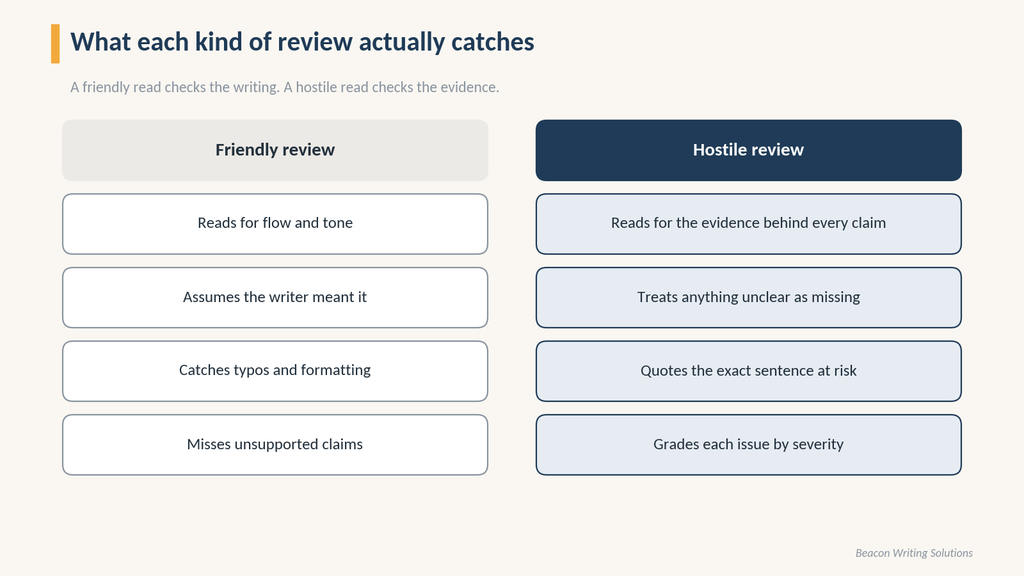
- A friendly proofread catches typos. It does not catch unsupported claims or missing process detail, the things that actually lose marks.
- A hostile review reads every claim asking “could we prove this today,” and every process asking who, how often, and what happens when it fails.
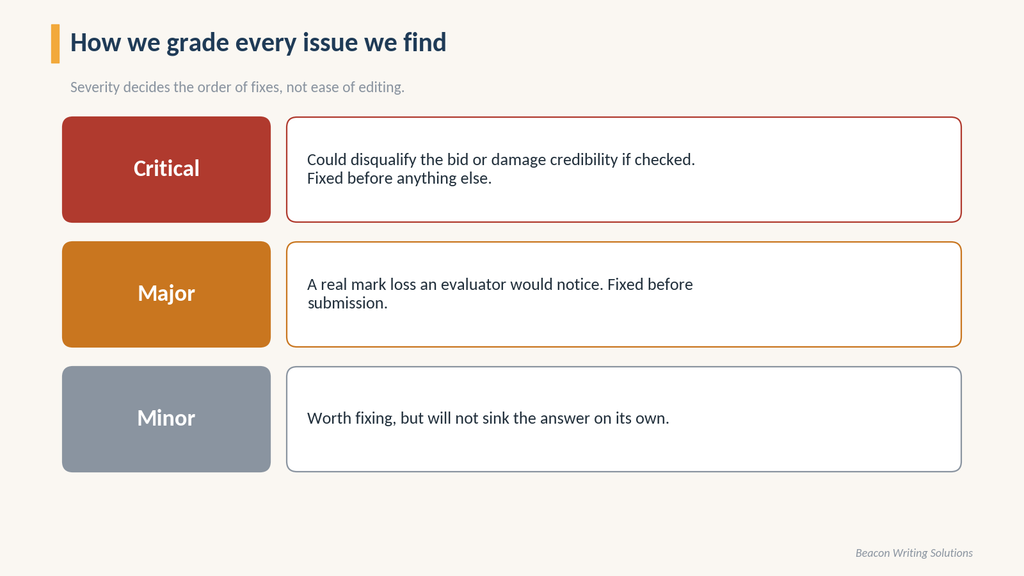
- Issues get tagged Critical, Major, or Minor, so fixes are prioritised by actual risk, not by what’s easiest to change.
Most tender reviews are friendly. A colleague reads the draft, nods along, flags a typo or two, and it goes out. That kind of review catches almost nothing that actually costs a bid marks.
At Beacon Writing Solutions, the review that matters happens after the friendly one, and it is deliberately hostile. We recently ran this process on a children’s disability outreach bid, and it’s worth explaining what that actually involves, because “we double-check our work” undersells it considerably.
The Brief We Give Ourselves
Before reviewing a word, we adopt a specific posture: sceptical by default, no benefit of the doubt, unclear treated as missing. If a claim isn’t backed by evidence in the text itself, it doesn’t count, however true it might be in reality. If a process is described without saying who does it, how often, and what happens when it goes wrong, that’s a gap, not a stylistic choice.
We then go through the draft line by line against the evaluator’s own scoring criteria, quoting the exact text that would trigger a mark-down, explaining why, and assigning it a severity: Critical, Major, or Minor. Critical means something that risks disqualification or reputational damage if checked. Major means a real mark loss an evaluator would notice. Minor is worth fixing but won’t sink the answer alone.
What This Actually Found
On the bid in question, this process caught two claims that read, on a friendly read-through, as perfectly reasonable local knowledge. On the hostile read, they were something more serious: statements written as established fact that the client couldn’t actually evidence, one implying an existing relationship with a named local institution the client had never worked with, another asserting a level of local operational familiarity the client didn’t yet have. Neither was dishonest in intent. Both were exactly the kind of claim a sharp evaluator, or worse, the institution named, could disprove.
We also caught something we didn’t expect to find: the client’s strongest section, a detailed case study with real, specific outcomes, was missing a risk assessment for the single most safety-critical fact in the whole narrative. It hadn’t been left out carelessly. It simply hadn’t been asked for explicitly by the question wording, so a friendly read wouldn’t have flagged it. A hostile one, reading the way an evaluator with safeguarding experience would read it, did.
Why This Has to Happen Before Submission, Not After
Every one of these issues was fixable in minutes once found. None of them would have been visible to the person who wrote the answer, because writing and reviewing your own work with genuine hostility is close to impossible. You already know what you meant. An evaluator doesn’t, and won’t give you the benefit of that knowledge.
This is the actual value a proper external review adds, not proofreading, but an adversarial read from someone with no stake in the answer being good, looking specifically for the gap between what was written and what a sceptical stranger would believe.
How to Run This Yourself, Even Without an External Reviewer
Not every team has access to an outside pair of eyes before a deadline, but the posture can be adopted internally with real discipline. Set a rule that any sentence making a specific claim, about a relationship, a capability, or a result, gets a note in the margin: could we prove this today, to a stranger, without caveats. Set a second rule that any process described in the answer needs four things stated somewhere nearby: who does it, how often, what tool or system supports it, and what happens when it fails. If either of those checks turns up a gap, treat it exactly as an external hostile reviewer would: as a defect to fix before submission, not a stylistic nicety to consider later.
The genuinely hard part is not the checklist. It’s holding the sceptical posture for an entire document, sentence by sentence, when you already know what you meant by every line. That’s precisely why the best version of this review is done by someone who wasn’t in the room when the answer was written. If that’s not available, the next best thing is distance: draft the answer, put it aside for at least a day, and come back to read it as if someone else wrote it and you’re being asked to find its weaknesses, not confirm its strengths.
Related reading: The Line That Nearly Cost a Bid Its Credibility looks at exactly the kind of claim this process is built to catch.