Key takeaways
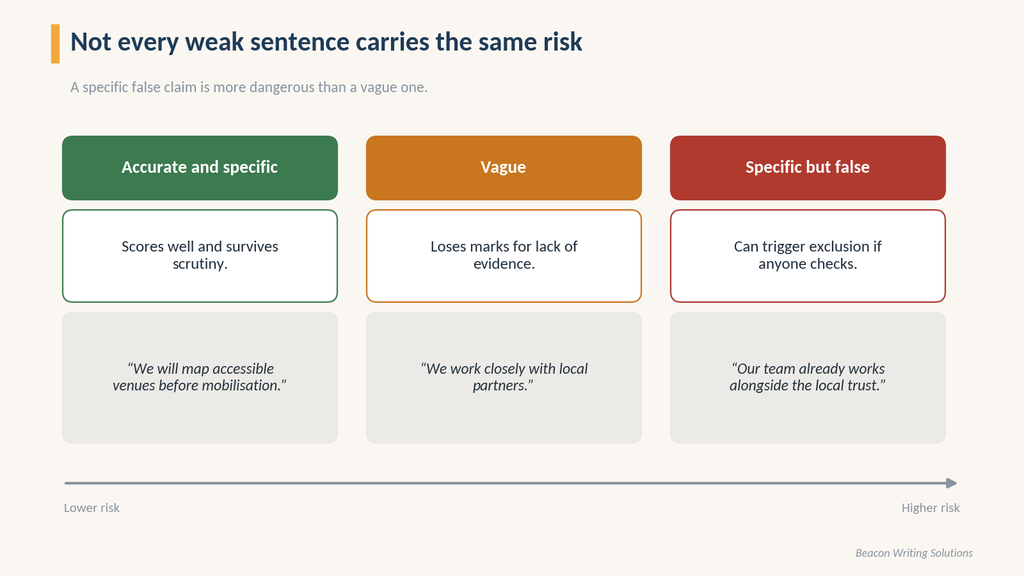
- A specific, confident, false claim is a bigger risk than a vague one, because most procurement frameworks define misrepresentation as grounds for exclusion.
- The fix is rarely deletion. It’s usually rephrasing an existing-relationship claim into an accurate statement of fact plus a future commitment.
- Test every specific claim with one question: could we prove this today, without caveats, to a stranger.
Some of the most dangerous sentences in a tender read perfectly well. They’re grammatically clean, confident, and entirely plausible. That’s exactly what makes them dangerous.
A Sentence That Looked Fine
While reviewing a recent children’s services bid, we found a line describing how the client’s outreach workers would coordinate with a specific, well-known local NHS trust, phrased in the present tense, as something already happening. It read naturally. It fit the paragraph. Nothing about it looked like a red flag on a normal read-through.
The problem was that the client had no actual working relationship with that trust. They knew, correctly, that it was the relevant local health provider. They had never delivered a service alongside it.
Why This Is Worse Than It Sounds
Most tender guidance warns against vague or generic writing. This wasn’t vague. It was specific, confident, and false, which is a different and more serious category of problem. A vague claim gets marked down for lacking evidence. A specific, false claim, if checked, whether by an evaluator who happens to know the sector, or by the named institution itself during due diligence, becomes a credibility problem that a low score can’t capture. Most public sector tenders explicitly define this kind of misrepresentation as grounds for exclusion, and for good reason.
The Fix Was Not to Delete It
The instinct when you find a claim like this is to cut it entirely. That would have been a mistake in a different direction, removing genuine, accurate local knowledge, that the client did correctly understand who the relevant local health partner was, purely because one sentence overstated the relationship.
The actual fix was smaller and more precise: reframe the same accurate knowledge, that this trust is the borough’s key health partner, as exactly that, a fact about the area, and separately state what the client would do once any relationship with a child’s actual health professionals existed, wherever those professionals happened to sit. The local knowledge stayed. The false implication didn’t.
The Lesson for Every Bid
The most persuasive sentence in a tender is often the riskiest one to leave unchecked. Fluency is not evidence. Before anything ships, every specific, confident claim about an existing relationship, a current capability, or an established practice needs one question asked of it directly: could we actually prove this if someone asked us to, today, not eventually. If the honest answer is no, the fix is almost never deletion. It’s usually a smaller, truer sentence sitting exactly where the bigger one used to be.
How These Sentences Hide From a Normal Read-Through
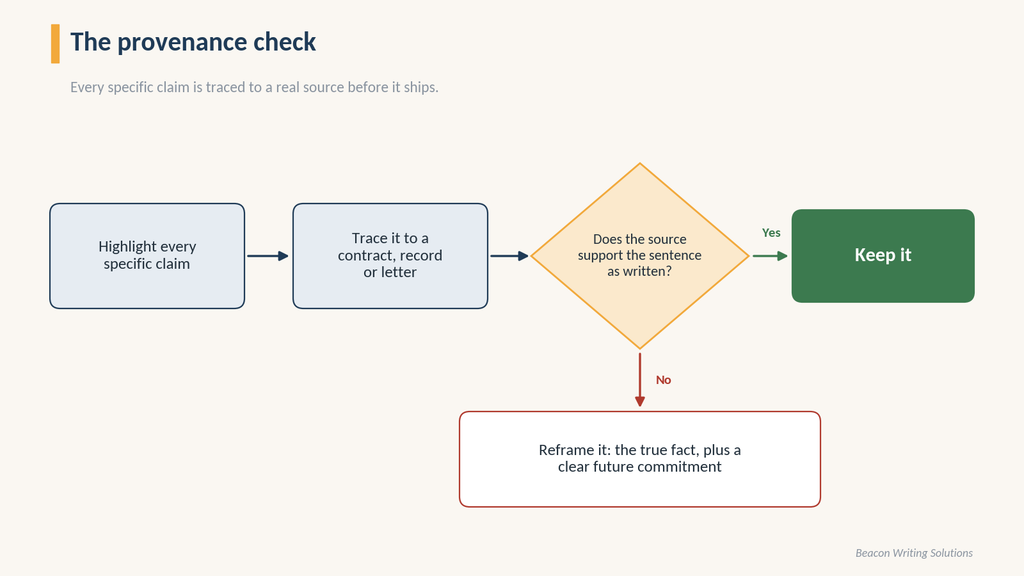
What makes this category of error so persistent is that it doesn’t look like an error at all. A typo announces itself. A missing word count doesn’t. A claim like this reads exactly like every other confident sentence around it, because it’s written with the same tone, the same grammar, the same level of apparent authority as the true claims sitting next to it. The only way to catch it reliably is to stop reading for flow and start reading for provenance: for every specific factual assertion, ask where it came from and whether that source actually supports the sentence as written, not just the general idea behind it.
A Habit Worth Building Into Every Review Pass
One useful discipline is to highlight, literally, every sentence in a draft that names a specific organisation, cites a specific number, or asserts a specific existing practice. Once those sentences are isolated from the surrounding prose, each one gets checked in isolation against its actual source: a contract, a piece of correspondence, a genuine internal record. Sentences that can’t be traced to something concrete get flagged immediately, regardless of how plausible or well-written they are. This is slower than reading for sense, but it catches exactly the category of mistake that reading for sense is designed to miss, because reading for sense rewards exactly the fluency that makes a false claim invisible.
Related reading: this is exactly the kind of issue a hostile-evaluator review is built to catch before submission.